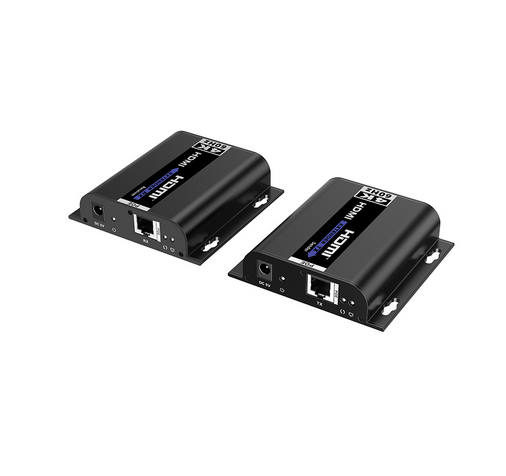
Grid 4K60 HDMI over IP & PoE Extender Kit | 1G Network, IR Passback, up to 200m over Cat6 | POEJK-HDMIE
Grid 4K60 HDMI over IP & PoE Extender Kit | 1G Network, IR Passback, up to 200m over Cat6 | POEJK-HDMIE
Available to order — ships from incoming stock
Typically ships in 2–5 Business Days (Western Canada) · 3–6 Business Days (Eastern Canada)
SKU:POEJK-HDMIE
Overview
POEJK-HDMIE is a 4K60 HDMI over IP & PoE extender kit that sends video, audio and IR over a 1G Ethernet network, up to 200 m over Cat6. It includes a transmitter and one PoE-powered receiver so you can move displays away from source gear without running long HDMI cables.
Designed for use with GRID PoE switches, this HDMI over IP extender fits naturally into a DC microgrid architecture—power and data ride on the same Cat6 infrastructure, and additional receivers (model POEJK-HDMIER) can be added where you need more screens.
Key features
- 4K60 HDMI over IP for high-resolution video transport across a standard 1G network.
- Up to 200 m over Cat6 between endpoints when installed with solid copper cabling and good terminations.
- PoE-powered receiver – reduce wall-warts and power bars behind TVs and projectors.
- IR pass back so you can control the source device from the remote display location.
- Kit includes transmitter + 1 receiver; extra receivers (POEJK-HDMIER) are available separately.
- Uses 1G Ethernet infrastructure instead of long dedicated HDMI homeruns.
- Ideal for digital signage, boardrooms, classrooms and hospitality displays where runs often exceed standard HDMI limits.
Technical highlights
| Parameter | Value |
|---|---|
| Model | POEJK-HDMIE |
| Function | HDMI extender kit over IP & PoE (transmitter + receiver) |
| Video support | Up to 4K at 60 Hz (4K60) |
| Transport | Over 1G Ethernet network |
| Maximum distance | Up to approx. 200 m over Cat6 (application and network dependent) |
| Power | Designed for PoE-powered operation on receivers (via compatible PoE switch) |
| Expansion | Additional receivers available as POEJK-HDMIER |
| Typical role | Video extension from source rack to one or more remote displays within the GRID network |
Ideal applications
- Digital signage in lobbies, corridors and retail aisles fed from a central AV rack.
- Boardrooms and training rooms where the source is in a credenza or closet but the display is across the room.
- Hospitality TVs in corridors or rooms where central sourcing simplifies service and content management.
- Educational and corporate campuses using existing Cat6 infrastructure instead of pulling dedicated HDMI bundles.
Compatibility & ecosystem
- Designed to sit on top of GRID PoE switching, using the same DC microgrid backbone as cameras and access points.
- Works over Cat6 cabling and standard 1G network switches, with PoE provisioning on the receiver side.
- Extra receivers (POEJK-HDMIER) extend the same source to additional displays, subject to network design and bandwidth.
- Pairs well with consolidation boxes (like POEJK-CPE1) and Active POE-Jack® wall plates for tidy, zone-based AV deployments.
Install & design notes
- For best results, use solid copper Cat6 and keep runs within the specified 200 m (or less) budget.
- Whenever possible, place HDMI sources and transmitters in a ventilated AV rack rather than above ceilings.
- Consider dedicating VLANs and QoS policies for HDMI over IP traffic so it doesn't’t contend with critical business data.
- Ensure your PoE switches have enough power budget for each receiver, especially in large signage or hospitality deployments.
- Test IR return paths and EDID behaviour on-site—display and source quirks can vary by manufacturer.
Canada-ready checklist
- “ Well-suited to longer runs in Canadian homes with projectors, bonus rooms and basement theatres.
- “ Ideal for commercial corridors, lobbies and classrooms where displays are far from equipment rooms.
- “ Uses low-voltage Cat6 cabling that installers are already pulling for networking and DC microgrid projects.
- “ Reduces the need for additional AC receptacles and power bars behind wall-mounted TVs.
Compatibility micro Q&A
Can I run this over my existing office LAN?
Sometimes. For light use (one or two endpoints), many sites run HDMI over IP on an existing 1G LAN or VLAN. For heavier deployments, a dedicated or well-segmented network is recommended—coordinate with IT.
Does it require Cat6, or will Cat5e work?
The published spec references up to 200 m over Cat6. Some shorter runs over Cat5e may work in practice, but the design assumption should be solid copper Cat6.
How many receivers can I add?
Additional receivers (POEJK-HDMIER) can be added within the limits of your switch capacity, network design and the extender’s supported topologies. Check the latest manufacturer guidance for scaling limits.
FAQ
Will this pass 4K HDR and multichannel audio?
The kit is specified for up to 4K60 video over a 1G network. Specific HDR formats and audio modes supported may depend on firmware; consult the latest spec sheet if you have strict format requirements.
Does this work point-to-point without a switch?
Many HDMI-over-IP kits can operate point-to-point with a small switch or direct link, but typical deployments use a 1G switch for flexibility and fan-out. Check your preferred topology against the latest documentation.
HDMI over IP systems should be installed and configured by qualified AV or IT professionals. Always follow local electrical and building codes, respect PoE limits and verify performance with the latest manufacturer documentation.